

Project Description
Energy Ink™ generates electrical energy from moisture in the air.
The Technology
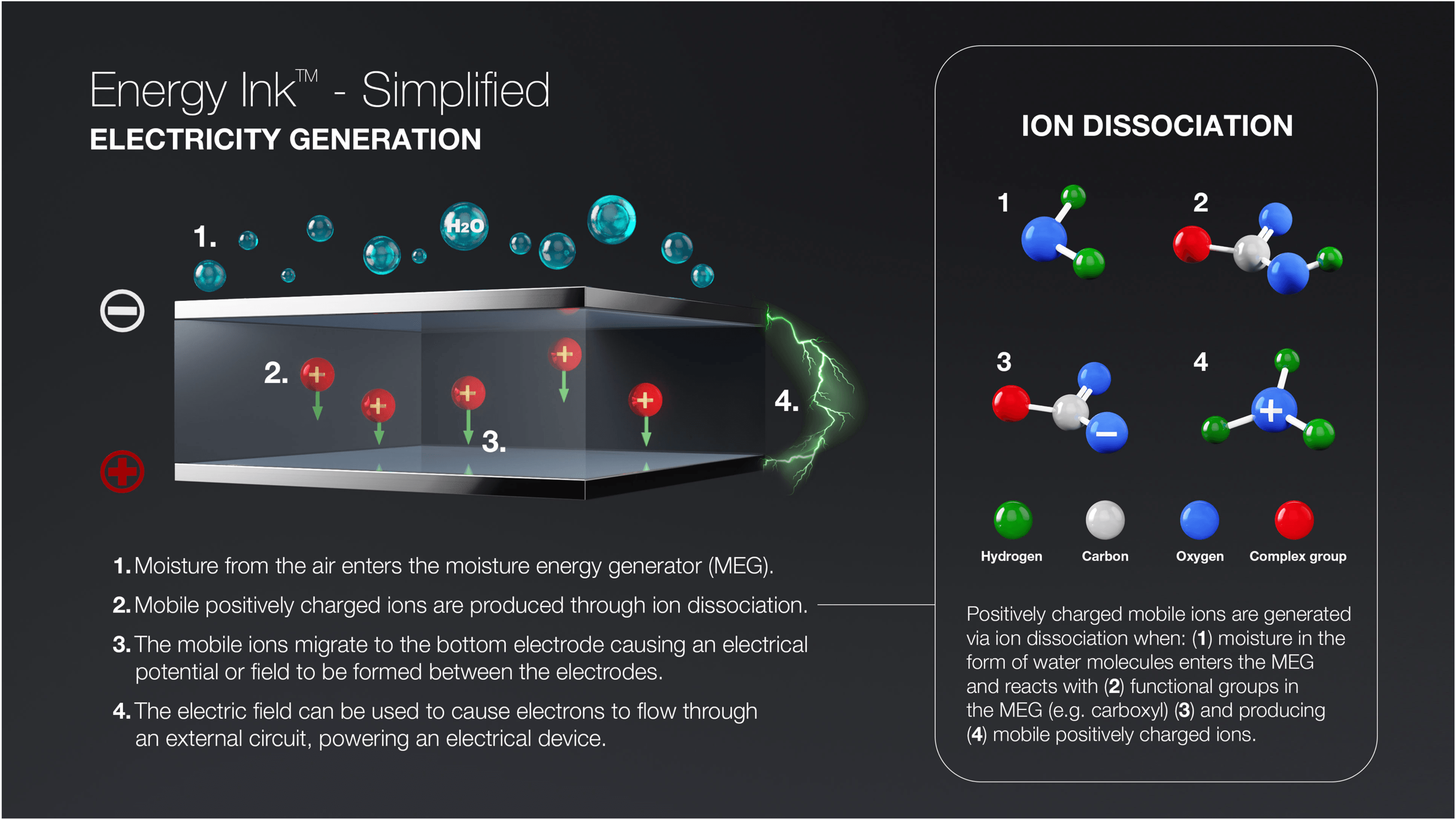
Energy Ink™ Technology
Energy Ink™ cells generate energy from moisture in the air. The technology is being developed for “battery denied” applications where new global rules make coin/button cells too risky, costly or complex to use in thin, disposable, high-volume formats.
Energy Ink™ differs from other renewable energy technologies in several key ways:
- Potential to regulate its energy source (moisture) within a dedicated unit, workable indoors/outdoors, day or night, which may improve versatility and consistency of supply.
- Energy generation from moisture enables cells to be stacked vertically, offering higher output in less space, unlike solar, which needs to be horizontally laid
- Super lightweight and thin layers made from environment-friendly, non-flammable materials enhance the potential for mobility, recyclability and safety.
- Printable fabrication processes are compatible with commercial printing techniques, supporting reproducibility and potential high-throughput manufacturing.
Development Team
The technology is being developed by 100% owned Australian Advanced Materials Pty Ltd in collaboration with Professor Dewei Chu at the University of New South Wales. Over multiple years, the Company has collaborated with organisations including VTT Finland, PrintoCent, CSIRO and portfolio company Stealth Technologies Pty Ltd. Strategic Elements believes it is building one of the world’s leading teams focused on moisture energy systems.
Energy Ink™ development has been supported through multiple competitive Federal research grants awarded under independent technical assessment, including an ARC Industry Fellowship awarded to Professor Dewei Chu for a $2.8 million project and a $1.6 million ARC Linkage Grant for wearable electronics and moisture electric generation with UNSW.
Development
Energy Ink™ remains an early-stage technology with development activities spanning printable moisture energy cells, engineered moisture systems and larger-scale energy generation concepts.
Recent activities have included the successful fabrication of more than 2,000 prototype cells in a commercial printing facility, demonstrating reproducibility using industrial equipment and establishing a foundation for future external collaborations and development programs.
Current work spans multiple concurrent programs, including longer-duration printable cells, engineered moisture activation systems and investigations into larger-scale moisture energy architectures. Development is focused on improving performance, reproducibility, fabrication methods and system-level integration while exploring practical pathways toward future commercial applications.